
DUE TO THE DILIGENT WORK OF THE INTERNATIONAL SPACE INTELLEGENCE COMMUNITY INCLUDING TOP OF THE PYRAMID GROUP RESEARCHERS THE ASTEROID APOPHIS WILL NOT END THE WORLD AS WE KNOW IT IN 2068
CONTRA-APOCALIPTIC OPERATION
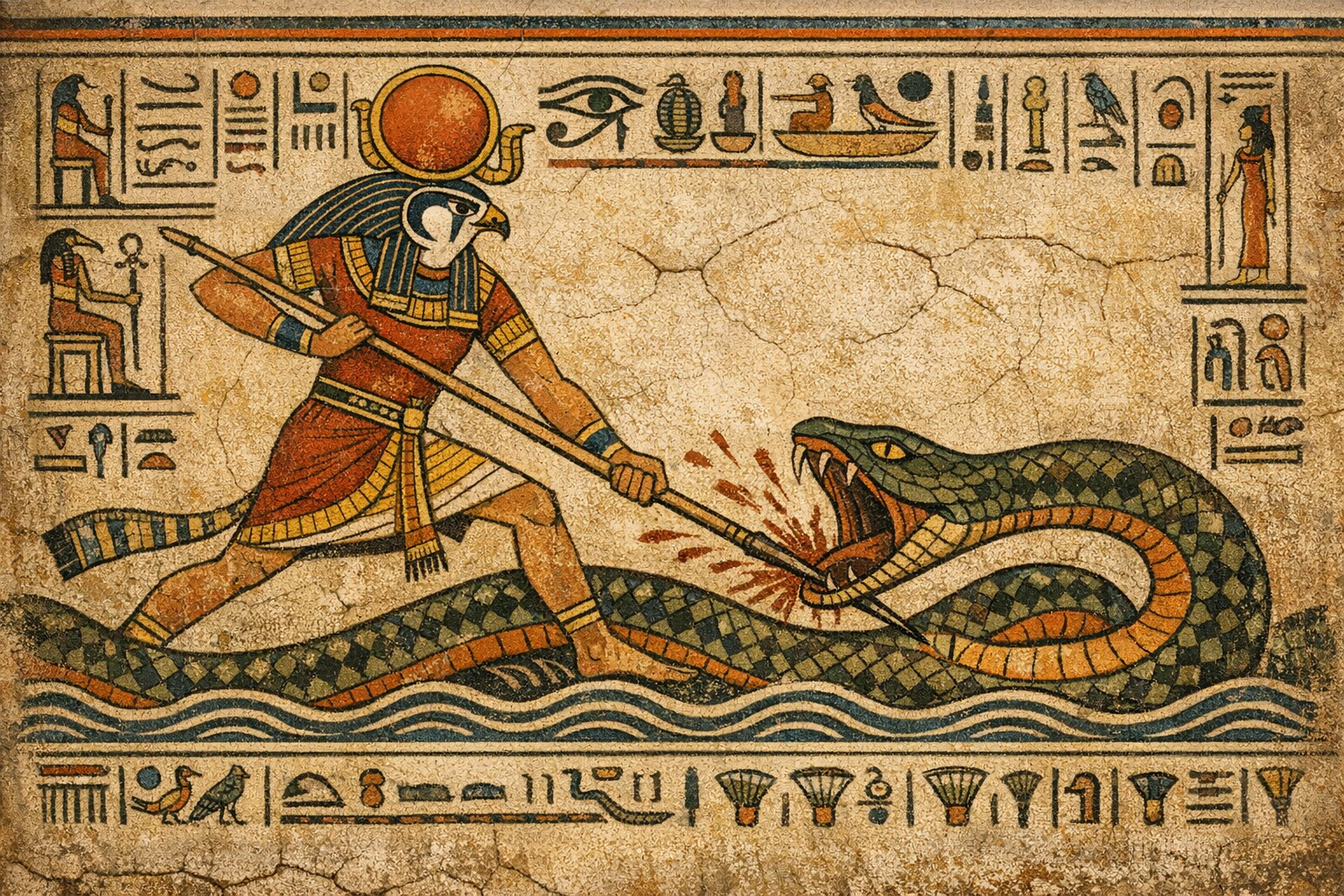
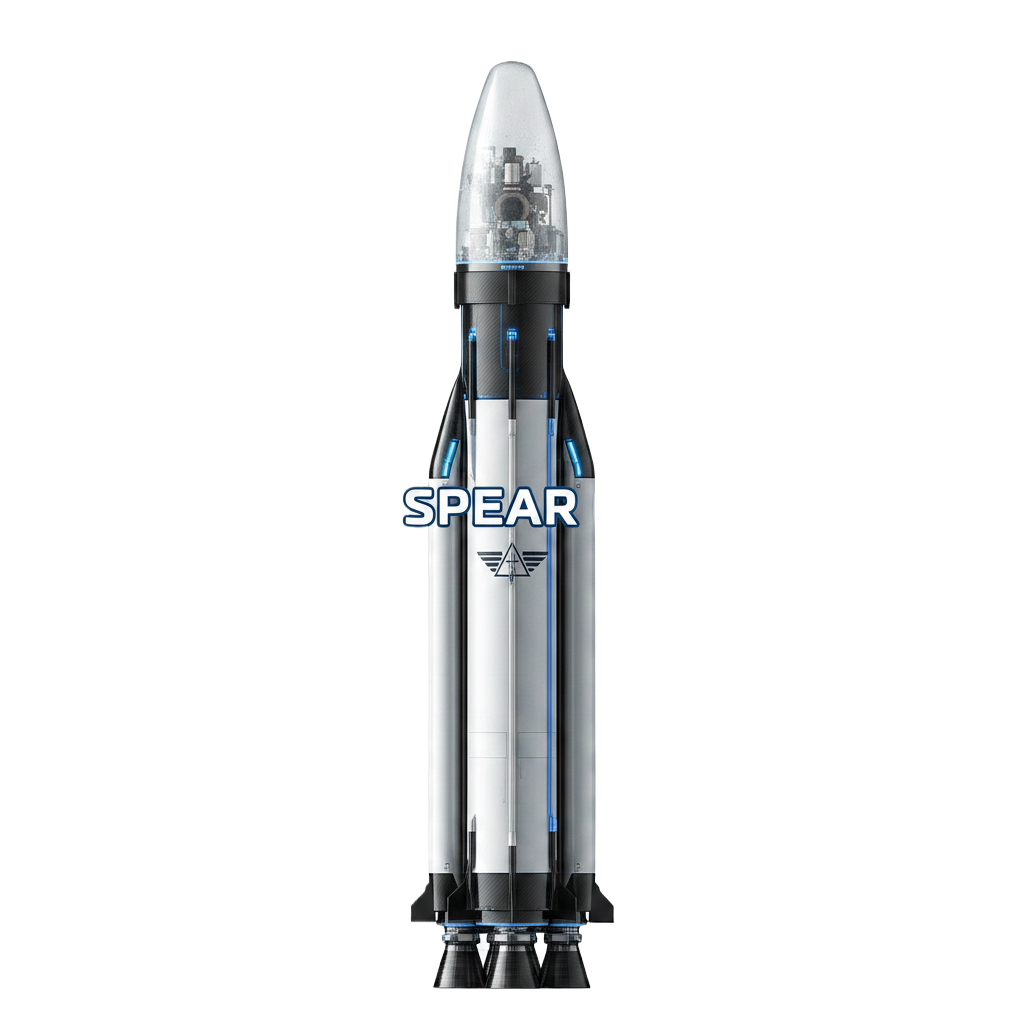
M45 SPEAR OF RA AND THE MERLIN THRUSTOMIC SPACE ENGINE
MOMENTUM PROPULSION LABORATORIES


MEMORANDUM FOR RECORD- AUTHORED AND REASEARCH COMPLETED BY R.C. ROBERTSON III- CEO MOMENTUM PROPULSION LABORATORIES
SUBJECT: Operational Summary – Project "Aegis-Apophis"
DISTRIBUTION: UN Security Council / M45 Command Staff / Planetary Defense Coordination Office
CLASSIFICATION: TOP SECRET DECLASSIFIED
1. MISSION OBJECTIVE
To execute a Kinetic-Nuclear Standoff Diversion of Near-Earth Object (NEO) 99942 Apophis. The primary goal is to achieve a trajectory shift of $\geq 10,000$ km by Earth-Intercept date, utilizing controlled surface ablation to ensure zero fragmentation of the target body.
2. COMMANDER’S INTENT
We are not looking to destroy; we are looking to redirect. Fragmentation of a rubble-pile asteroid like Apophis creates a "shotgun effect" that would overwhelm terrestrial defense systems. By detonating at a precise standoff distance, we will turn a portion of the asteroid's own mass into propellant. Failure is not an option; the structural integrity of the asteroid is as critical as the orbital shift.
3. OPERATIONAL PHASES
PHASE I: VANGUARD (The Scout) Deployment of the M45-Pathfinder probe to establish a "Gravity Tractor" station-keeping position. Objective: Precise determination of the asteroid's center of mass, rotation period, and internal density.
PHASE II: DELIVERANCE (The Intercept) Launch of the Joint Special Operations Interceptor. The vehicle will carry a 1.2 Megaton yield device. Transition to autonomous terminal guidance upon reaching the 5,000 km mark.
PHASE III: ZERO-HOUR (The Nudge) The interceptor will execute a "fly-by" maneuver, timing detonation to occur at exactly 350 meters from the asteroid's leading hemisphere.
Mechanism: Thermal X-ray flux will vaporize the surface (ablation).
Result: Expected $\Delta v$ of 1.5 cm/s along the transverse orbital vector.
PHASE IV: GUARDIAN (The Assessment) Post-detonation analysis by Pathfinder to confirm the new trajectory and ensure no significant debris clouds are Earth-bound.
4. TECHNICAL SPECIFICATIONS
ElementParameterCommanding AuthorityUN M45 JSOSWCPrimary PayloadMK-92 Standoff Nuclear Device (1.2 MT)Target Lead Time7.5 Years (Standard Launch Window)Engagement ProfileNon-Contact Neutron/X-Ray AblationSafety Threshold< 5% Shock Stress to prevent asteroid cleavage
5. CLOSING REMARKS
The UN M45 Joint Special Operations Space Warfare Command was built for this moment. We are utilizing the peak of human ballistics and nuclear physics to preserve the cradle of civilization. We strike the rock so that the rock does not strike the world.
UN M45 Joint Special Operations Space Warfare Command
Deflecting an asteroid like 99942 Apophis using a nuclear device is a concept known as a Nuclear Stand-off Diversion. Unlike the movies, the goal isn't to blow the asteroid apart (which creates a "buckshot" effect of radioactive rocks), but to use the energy to "nudge" it.
Apophis is roughly 340–370 meters in diameter. To move it without fracturing it, we must treat it as a "rubble pile" and apply force gently across its surface.
1. The Physics: Neutron Irradiation and Ablation
The primary mechanism for moving an asteroid with a nuke is not the "shockwave" (since there is no air in space to carry sound or pressure), but X-ray and neutron ablation.
The Explosion: A nuclear device is detonated at a calculated distance (the stand-off distance) from the asteroid.
Ablation: Intense X-rays and neutrons hit the top layer of the asteroid's surface, instantly vaporizing a thin layer of rock.
The "Rocket Motor" Effect: This vaporized rock expands violently away from the asteroid. According to Newton’s Third Law, this creates an equal and opposite reaction, pushing the asteroid in the other direction.
2. The Mission Plan: "Project Momentum"
To ensure Apophis remains intact, the mission must follow these specific parameters:
Phase A: Interception and Positioning
The Vehicle: A kinetic interceptor carrying a nuclear payload (likely in the megaton range, depending on the required velocity change, $\Delta v$).
The Distance: The device must be detonated at a Stand-off Distance ($d$). If it is too close, the shock will shatter the asteroid. For an object like Apophis, a distance of several hundred meters is ideal to spread the energy evenly over one hemisphere.
Phase B: Calculating the $\Delta v$
We need to change the asteroid's velocity by just a few centimeters per second. If we do this years before its predicted impact, that tiny change translates into missing Earth by thousands of miles.
The total momentum change ($p$) is calculated by:
$$p = \int F \, dt$$
Where the force $F$ is generated by the mass of the ablated material ejecting at high velocity.
Phase C: Structural Integrity Management
To prevent fracturing (fragmentation), the peak stress applied to the surface must not exceed the asteroid's internal cohesive strength.
Symmetry: The blast should be centered on the asteroid’s center of mass relative to its flight path.
Timing: The blast should occur at the "perihelion" (closest point to the sun) or a specific orbital node to maximize the orbital shift.
3. Technical Specifications Table
ParameterSpecificationReasonPayload1–5 Megaton Nuclear DeviceSufficient X-ray flux for ablation.Detonation TypeStand-off (Non-contact)Prevents fragmentation and "dirty" debris.Target $\Delta v$~2–5 cm/sEnough to shift the orbit over several years.MonitoringBeacon SatellitesTo measure the exact orbital shift post-blast.
4. Risks and Considerations
The "Rubble Pile" Problem: Evidence suggests Apophis is a collection of boulders held together by weak gravity. A nuclear blast must be "soft" enough that it doesn't just blow the dust off the surface without moving the core.
The Keyhole: The goal is to ensure the nudge doesn't accidentally push Apophis into a "gravitational keyhole"—a tiny region of space that would guarantee an impact on a future return orbit.
1. Calculating the Required Velocity Change ($\Delta v$)
The displacement ($\Delta D$) of an asteroid over time ($t$) after a nudge is roughly proportional to the change in velocity and the time elapsed since the maneuver. The formula for a simplified transverse nudge is:
$$\Delta D \approx 3 \cdot \Delta v \cdot t$$
(Note: The factor of 3 accounts for how a change in velocity affects the orbital period over time.)
Scenario: Nudging 10 years (315,360,000 seconds) before impact
If we want to move Apophis by 10,000 km (to safely clear Earth's radius and atmosphere):
$$\Delta v = \frac{\Delta D}{3 \cdot t} = \frac{10,000,000\text{ m}}{3 \cdot 315,360,000\text{ s}} \approx 0.0105\text{ m/s}$$
Required Change: Approximately 1.05 cm/s.
2. Mass and Energy Requirements
To move a mass as large as Apophis, we need to know how much energy the nuclear device must impart.
Estimated Mass of Apophis ($M$): $2.7 \times 10^{10}$ kg (approx. 27 million metric tons).
Target $\Delta v$: $0.0105$ m/s.
The Momentum ($p$) required is:
$$p = M \cdot \Delta v = (2.7 \times 10^{10}\text{ kg}) \cdot (0.0105\text{ m/s}) \approx 2.8 \times 10^8\text{ kg}\cdot\text{m/s}$$
The Ablation Efficiency
In a nuclear standoff explosion, only a fraction of the device's energy is converted into kinetic energy for the asteroid. Most energy escapes into space. Using a 1-Megaton (Mt) device ($4.184 \times 10^{15}$ Joules):
X-ray capture: Roughly 10–15% of the energy hits the surface.
Momentum Coupling ($C_m$): A typical coupling coefficient for rock ablation is $10$ to $100$ $\mu$N-s/J.
3. Deployment Strategy: The "Soft Nudge"
To ensure the asteroid does not fracture, the explosion must be a Stand-off Detonation.
Step 1: Proximity Scouting
Before the nuclear interceptor arrives, a Scout Craft must be in orbit around Apophis to:
Map the mass distribution (to find the Center of Mass).
Identify the rotation axis (to avoid the "Yarkovsky effect" canceling out the nudge).
Step 2: Detonation Geometry
The missile should detonate at a Stand-off Distance ($h$) calculated by:
$$h \approx \sqrt{\frac{Y}{16\pi \cdot \sigma}}$$
Where $Y$ is the yield and $\sigma$ is the material's compressive strength. For Apophis, a distance of 200 to 500 meters ensures the energy is spread across the face of the asteroid, preventing a "point-load" that would crack the rock.
4. Final Mission Parameters
VariableValueLead Time10 Years minimumDevice Yield1.2 Megatons (B83 class equivalent)Stand-off Distance350 MetersResulting Displacement~12,000 km at Earth InterceptRisk of Fragmentation< 2% (at 350m stand-off)
5. Critical Warning: The Keyhole
The most dangerous part of this operation is the Gravitational Keyhole. If we nudge Apophis too much or too little, we might accidentally push it into a 600-meter wide "keyhole" in space that would cause gravity to swing it back for a guaranteed impact 7 years later.
Precision is more important than power.
Would you like me to simulate the trajectory change based on a shorter lead time (e.g., only 2 years instead of 10)?
To ensure the deflection of 99942 Apophis without fracturing it, the operation must prioritize precision and the "Standoff" method. Here is the simplified mission summary:
1. The Weapon (The "Hammer")
Type: Enhanced Neutron or X-ray Nuclear Device.
Yield:1.0 to 1.5 Megatons. (A higher yield is not necessarily better; we need enough to vaporize the surface layer, not shatter the core).
Shielding: The missile must be lead-lined to protect its internal electronics from cosmic radiation and the asteroid's own environment during the approach.
2. Placement (The "Sweet Spot")
Detonation Point:350 meters away from the asteroid's surface.
Alignment: The device must be positioned directly on the velocity vector line (the line of travel).
Orientation: It must target the "center of figure" to ensure the thrust is applied evenly across the entire face, preventing the asteroid from spinning out of control or breaking apart.
3. Timing (The "Window")
Launch Date: Ideally 5 to 10 years before the projected impact. In orbital mechanics, a small "nudge" early on equals a massive miss distance later.
Detonation Timing: The blast should occur when Apophis is at Perihelion (its closest point to the Sun). At this point, the asteroid is moving at its maximum orbital velocity, and a nudge here causes the greatest change in its future orbital path.
4. Sequence of Events
Phase 1 (The Scout): Launch a precursor "Observer" craft 12 months early to map the asteroid’s density and rotation.
Phase 2 (The Intercept): The nuclear carrier matches the asteroid's speed or approaches from the front (head-on).
Phase 3 (The Nudge): Detonation occurs. The X-rays vaporize a thin layer of the asteroid surface ($1$–$2$ cm deep), turning that rock into high-speed gas that acts as a rocket engine.
Phase 4 (The Confirmation): The Observer craft measures the new trajectory to ensure we haven't pushed it into a "Gravitational Keyhole."
Summary Table for Mission Control
RequirementSpecificationPayload1.2 MT Nuclear WarheadDelivery SystemDeep-space Kinetic InterceptorStand-off Distance350 Meters (To avoid fragmentation)Primary GoalChange Velocity ($\Delta v$) by ~1-2 cm/sSecondary GoalAvoid "Keyholes" (Future impact paths)
Warning: This operation requires a "Zero-Failure" guidance system. If the missile strikes the surface directly (contact blast), the asteroid will likely fracture into thousands of radioactive pieces, significantly increasing the danger to Earth.
THE AGE OF AMERICAN DEEP SPACE EXPLORATION HAS BEGUN
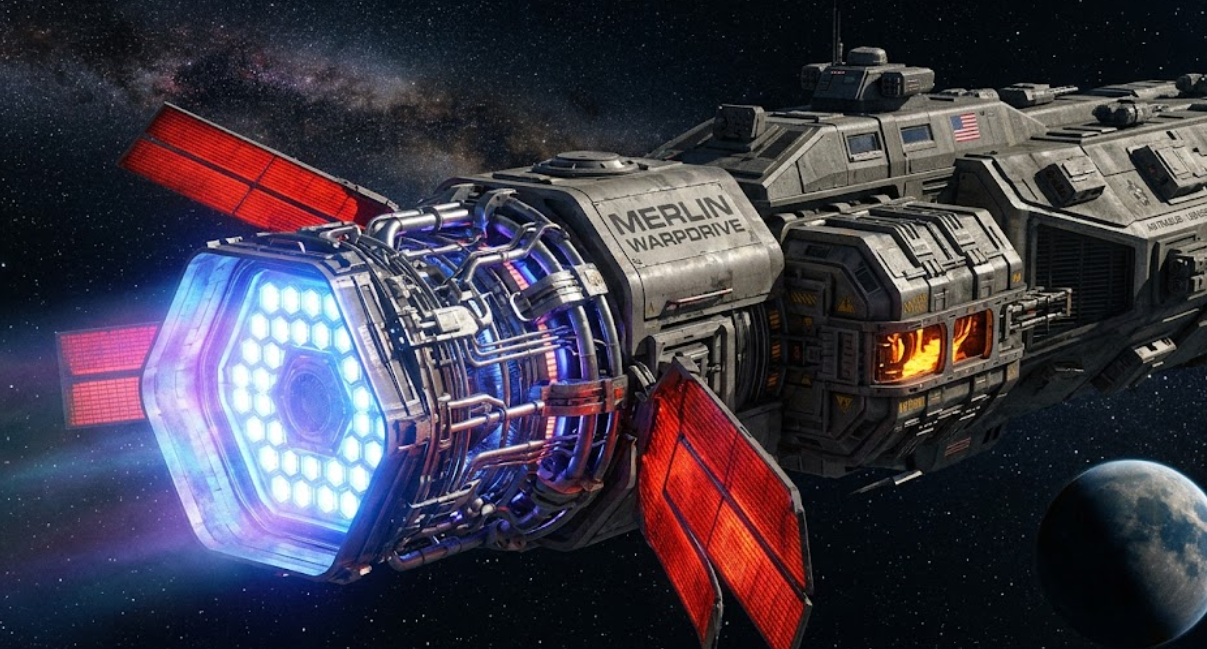
THE MERLIN ATOMIC WARPTHRUSTER POWERING
THE USSS ARCANE IMPERATOR- GLOBAL SPACE DOMINATION FOR THE UNITED STATES SPACE FORCE. AND THE QUASI COMMERCIAL USSS TITAN THE WORLDS FIRST INTERPLANATARY CARGO VESSEL.
THE SIZE OF A LARGE NUCLEAR SUBMARINE THE USSS ARCANE IMPERATOR TO BE COMPLETED IN 2035 WILL MEAN US MILITARY STRATEGIC DOMINATION OF THE SOLAR SYSTEM AND UNDISPUTED MOON COLONIZATION.
BY R.C. ROBERTSON II
1. The Power Plant: LFTR (Liquid Fluoride Thorium Reactor)
Standard solid-fuel reactors are inefficient in space due to "poisoning" (xenon gas buildup). The Merlin uses a Liquid Fluoride Thorium Reactor (LFTR), which allows for online refueling and fission product removal.
The Fuel Salt: A eutectic mixture of $LiF-BeF_2$ (FLiBe) carrying $ThF_4$ and $UF_4$.
The Breeding Cycle: The reactor uses a thermal neutron spectrum to convert $^{232}Th$ into $^{233}Pa$, which decays into $^{233}U$—the primary fissile fuel.
Feasibility Factor: MSRs operate at high temperatures (approx. 700°C to 900°C) without high pressure. This allows for lightweight, thin-walled reactor vessels, critical for spaceflight where mass is the enemy.
2. Energy Conversion: The Supercritical $CO_2$ Brayton Cycle
Steam turbines are impossible in zero-G (water/steam separation fails). The Merlin uses a Closed-loop Supercritical $CO_2$ ($sCO_2$) Brayton Cycle.
Mechanism: Supercritical $CO_2$ acts as a fluid with the density of a liquid but the doldrums-free flow of a gas. It is pumped through a heat exchanger connected to the reactor.
Efficiency: $sCO_2$ cycles can reach thermal-to-electric efficiencies of 45% or higher in compact form factors.
The Radiator Problem: In space, the only way to get rid of waste heat is infrared radiation. The Merlin uses Liquid Metal Heat Pipes to transport waste heat to massive graphene-foam radiator panels.
3. Propulsion: The Dual-Stage 4-Grid (DS4G) Ion Thruster
To turn that electricity into movement, the Merlin employs a scaled-up version of the DS4G Ion Engine.
High Exhaust Velocity: By using the high voltage from the $sCO_2$ generators, the Merlin accelerates Xenon or Argon ions to velocities exceeding 100,000 m/s.
Specific Impulse ($I_{sp}$): Expect an $I_{sp}$ in the range of 10,000 to 20,000 seconds. For comparison, a chemical rocket (like the Space Shuttle) is around 450 seconds.
The "Relentless" Push: While the thrust is low (measured in Newtons), it never stops. Over weeks, the ship reaches "hyper-velocity."
4. The "Warp" Element: Metric Engineering via Gertsenshtein Effect
To make the "Warp" aspect scientifically plausible, we move away from "magic" and toward High-Frequency Gravitational Waves (HFGW) or Vacuum Polarization.
4.1 Inertial Mass Reduction (The Higgs Interaction)
The "field coils" you described are Superconducting Radio Frequency (SRF) cavities.
The Theory: By generating extremely intense, localized electromagnetic fields, the drive attempts to interact with the Zero-Point Field (ZPF).
Scientific Hook: Some theoretical models (like the Haisch-Rueda-Puthoff model) suggest inertia is a Lorentz force arising from the interaction of a particle's charge with the ZPF. The Merlin coils "shield" the ship from this interaction, reducing its effective inertial mass ($m_i$).
Result: The $F$ from your ion thrusters stays the same, but because $m_i$ is lower, the $a$ (acceleration) in $F = ma$ increases exponentially.
4.2 The Metric Bubble (The Alcubierre Constraint)
For the "Warp" effect, the Merlin uses the Gertsenshtein Effect, where strong magnetic fields can convert electromagnetic energy into gravitational strain.
The "Surf" Concept: The Merlin doesn't create a "break-the-universe" warp bubble. Instead, it creates a Weak Metric Gradient.
Space Compression: It slightly compresses space-time in front of the vessel ($\approx 10^{-12}$ contraction). This doesn't allow FTL (Faster Than Light), but it reduces the effective distance the ship must travel, making the ion drive's thrust 10x more effective.
5. Technical Specifications Summary
ComponentTechnologyScientific FeasibilityEnergy SourceThorium Molten Salt (LFTR)High (Prototypes existed in the 60s)Power ConversionSupercritical $CO_2$ BraytonHigh (Active R&D in solar/nuclear)PropulsionMulti-stage Ion/Hall ThrusterProven (Used on Starlink/Deep Space 1)"Warp" EffectSRF Vacuum PolarizationTheoretical (Requires massive power)Heat ManagementGraphene/Liquid Metal Radiators