


PENTAGON PARTNERS MFG
TOP OF THE PYRAMID GROUPS DEFENCE THINK TANK IS AN AWARD WINNING INOVATION ENGINE FOR THE UNITED STATES MILITARY ITS CEO R.C. ROBERTSON III, WAS RECOGNIZED AS ONE OF THE MOST INNOVATIVE INVENTORS AND ENTREPRENEURS IN THE UNITED STATES AT AGE 19 BY ELON MUSK AND PETER THIEL.
PERMENANT PEACE THROUGH GREAT STRENTH
𓊪𓂋𓅓𓈖𓄿𓈖𓏏 𓊪𓄿𓎢 𓏏𓉔𓂋𓅲𓎼𓉔 𓎼𓂋𓄿𓏏 𓋴𓏏𓂋𓈖𓏏𓉔

✠ SMART GUNS ✠ MILITARY ENGINES ✠ A.A.I. ✠ ANTI DRONE ✠ ARMOR ✠

DEVELOPING KEYSTONE TECHNOLOGIES FOR NATO DEFENCE


THE WORLDS FIRST GEOFENCED MILITARY AND CIVILION WEAPONRY…. GUNS CONTROLED AND GEOFENCED VIA SATELITE
THE WORLDS FIRST GUNS THAT CAN NOT FIRE WITHIN 500 FEET OF SCHOOLS AND POLICE VEHICLES.
THE NEXT GENERATION OF MILITARY AND COMMERCIAL DIESEL HYDROGEN HYBRID I.C. ENGINE
TOMCAT THE TANK ENGINE
5 TIMES MORE FUEL EFFICIENT AND MORE POWERFULL THAN THE CURRENT ABRAMS JET ENGINE.
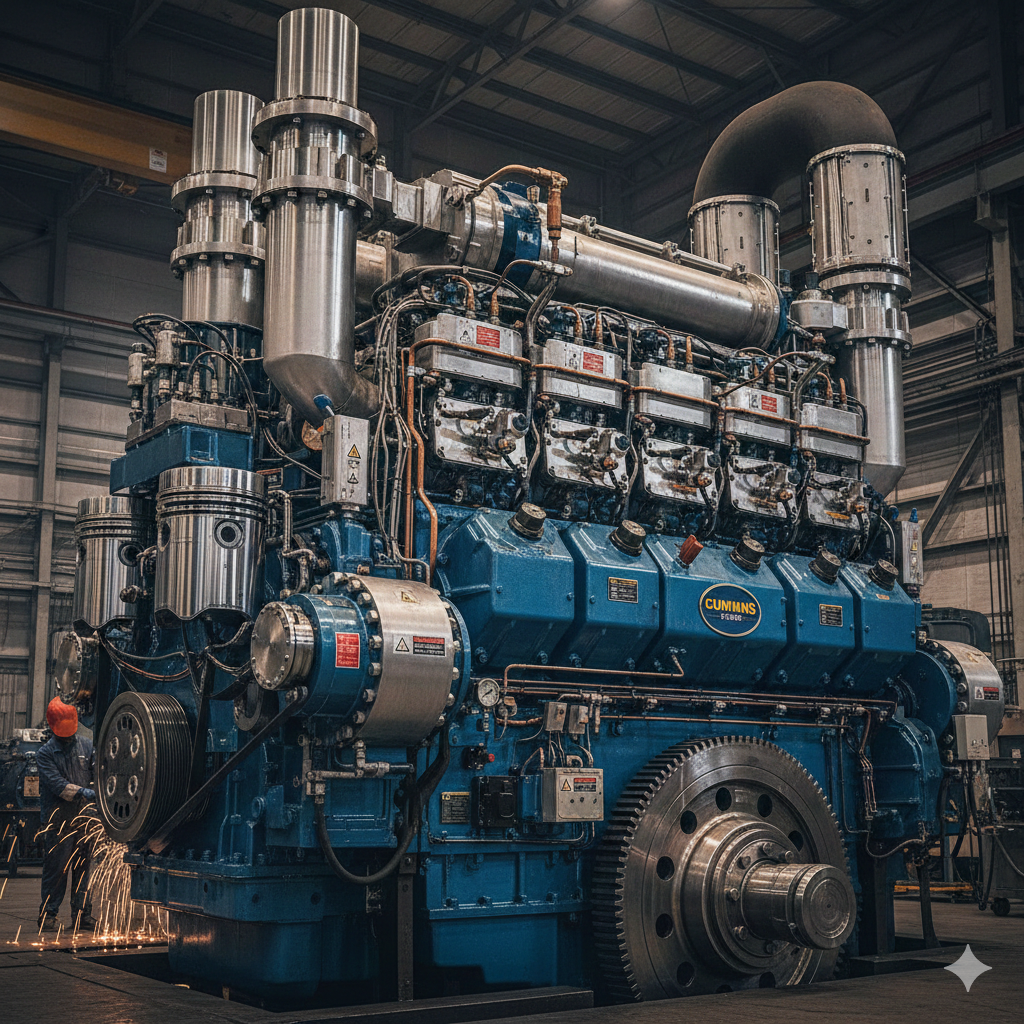
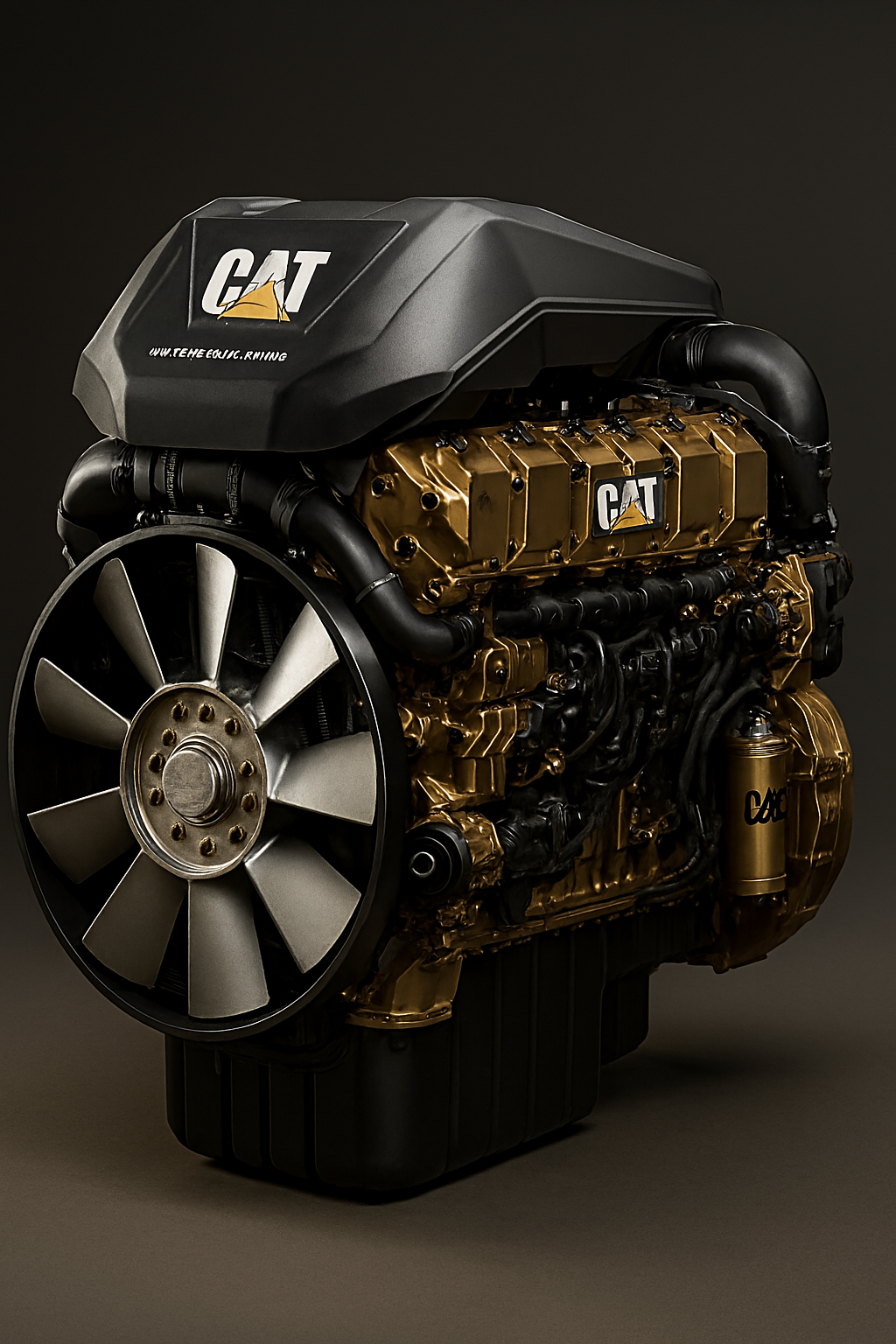
Introducing the Apex-H V12: HYDROGEN DIESEL HYBRID The New God of Industrial and Military Power
There are engines that move vehicles, and then there are engines that move the world. The Apex-H V12 belongs to the latter. Designed for those who refuse to acknowledge the limits of physics, this is a quad-turbocharged, hydrogen-boosted diesel titan engineered to deliver a level of violence—and precision—never before seen in internal combustion.
The Heart of a Titan
At the core of the Apex-H lies a 20.0L Compacted Graphite Iron (CGI) block, a material born from the aerospace industry to handle pressures that would turn standard engines into shrapnel. This isn't just an assembly of parts; it is a masterpiece of metallurgy designed to thrive under the crushing weight of 5,000+ lb-ft of torque.
Quad-Turbocharged Dominance
Why settle for two when you can have four? Our Series-Sequential Quad-Turbo system eliminates the concept of "lag." Two high-response primary chargers provide instantaneous low-end grunt, while two massive secondary atmospheric chargers take over to scream toward a staggering 3,500+ Brake Horsepower.
The Hydrogen Edge: Clean Fire, Raw Power
The Apex-H doesn’t just burn fuel; it optimizes it. By integrating a proprietary Hydrogen-Assisted Combustion (HAC) system, we inject molecular hydrogen into the intake stream. This acts as a chemical catalyst, accelerating the diesel flame front to near-supersonic speeds.
The result: A 98% fuel burn efficiency, reduced thermal waste, and a power curve that climbs like a vertical wall.
Performance by the Numbers
Peak Torque: 5,200 lb-ft (Available from 1,600 RPM)
Peak Power: 3,650 BHP
Induction: 95 PSI of Compound Boost
Fueling: Dual-Stage Common Rail + Direct Hydrogen Injection
"The Apex-H V12 is not an evolution. It is a mechanical revolution. We didn't build it to compete; we built it to render the competition obsolete.
SCARAB
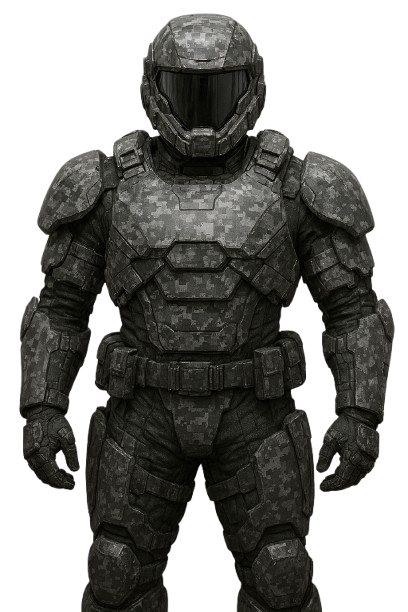
THE WORLS FIRST BATTLEFIELD READY 3D GRAPHENE ARMOR PRINTER
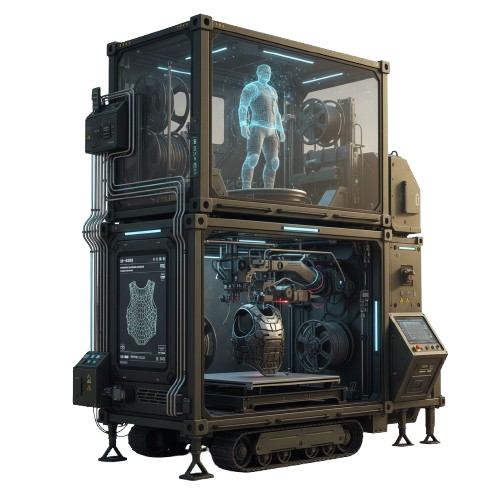
SCARAB
M-GAFU
1. The Design: Mobile Graphene Armor Fabrication Unit (M-GAFU)
The system consists of three integrated modules: a 3D Body Scanner, a Lattice-Optimization Engine, and a Multi-Material SLS/FFF Hybrid Printer.
A. The Input: Digital Twin & Lattice Mapping
Volumetric 3D Scanner: Uses LiDAR and photogrammetry to create a 1:1 "Digital Twin" of the soldier.
Dynamic Articulation Analysis: The software maps the soldier's range of motion to determine where "Hard" plates should end and "Flexible" graphene-polymer joints should begin, inspired by medieval plate armor.
Tubulane Lattice Infill: The armor is not solid. The printer uses a Tubulane or Gyroid internal structure. These complex geometries are designed to collapse in specific sequences to absorb kinetic energy from high-velocity NATO 7.62mm or 5.56mm rounds.
B. The Printer: SLS/FFF Hybrid System
Technique: Selective Laser Sintering (SLS) combined with Direct Energy Deposition.
Material Feed: A proprietary filament or powder made of Graphene-Infused PEEK. Graphene nanoplatelets are dispersed at approximately 0.5 wt% to 1.0 wt% to increase tensile strength and energy absorption by up to 25%.
Laser Treatment: A secondary CO2 laser "flashes" the surface of each layer to ensure perfect Interfacial Adhesion, preventing the delamination common in traditional 3D prints.
THE NEW NATO-STARDESTROYER FLYING SUPERFORTRACE
THE WORLDS FIRST ULTRALIGHT-ARMOR GRAPHENE SUPER ARMORED NUCLEAR MMS-REACTOR POWERED AIRSHIP
UTALIZING THE WORLDS SMALLEST NUCLEAR REACTOR AND ULTRA LIGHT GRAPENE ARMOR AND BATTERIES THE PENTAGON PARTNERS STAR DESTROYER REPRESENTS THE NEXT GENERATION OF AIR FORCE DOMINANCE.
UNDER-CONSTRUCTION IN ITALY, FOR THE HOLY ROMAN EMPIRE…
CAPABLE OF TAKING ON AN ENTIRE NATIONS AIRFORCE SINGLE HANDEDLY… AND WINNING THE BATTLE.

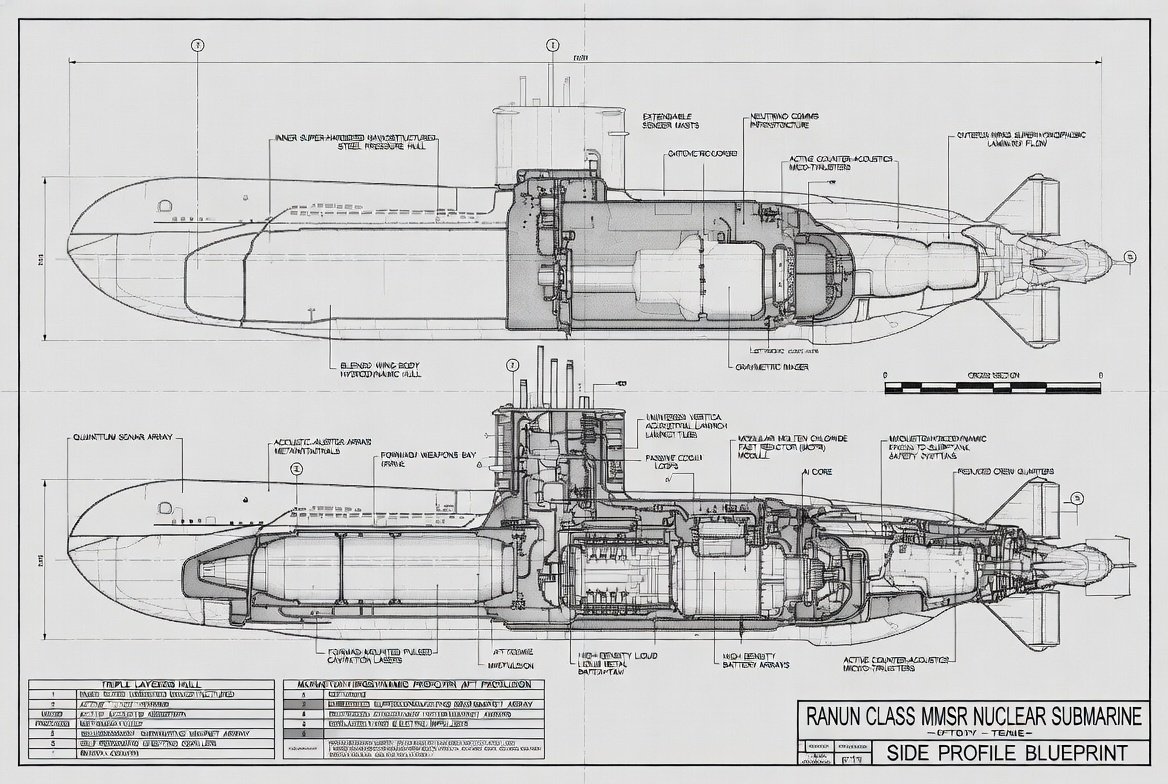
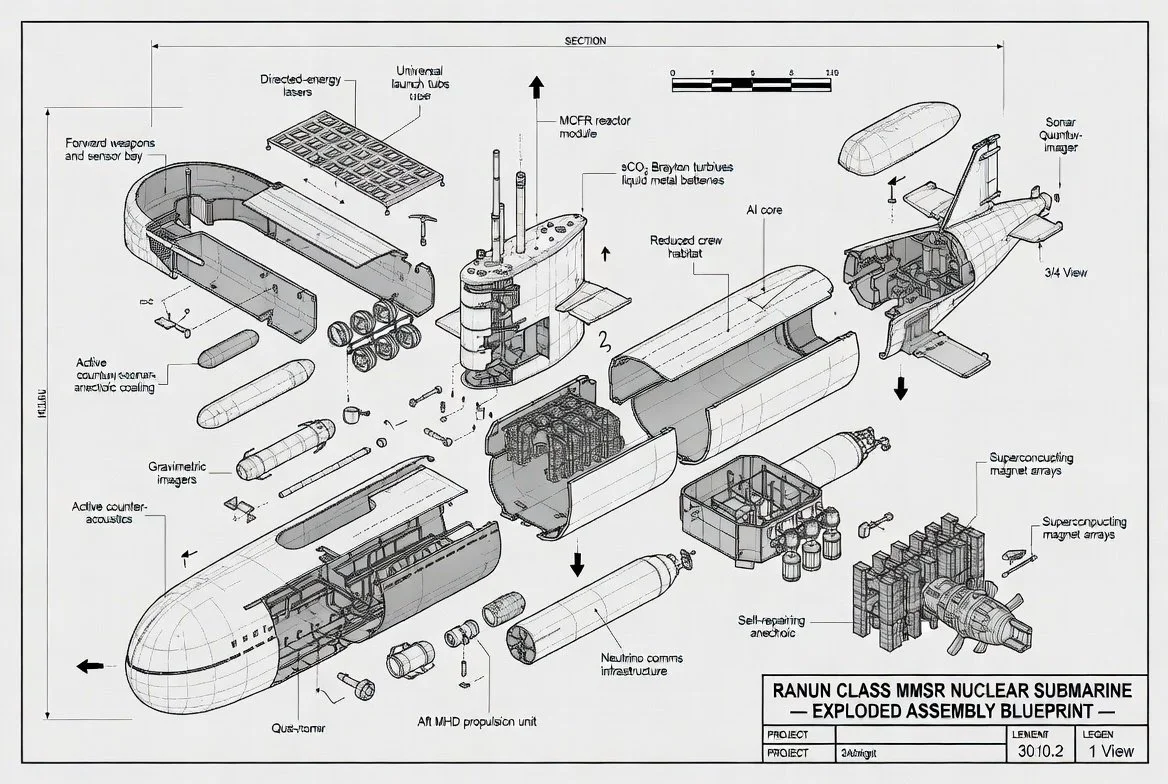
RANUN CLASS MMSR POWERED
SUBMARINE
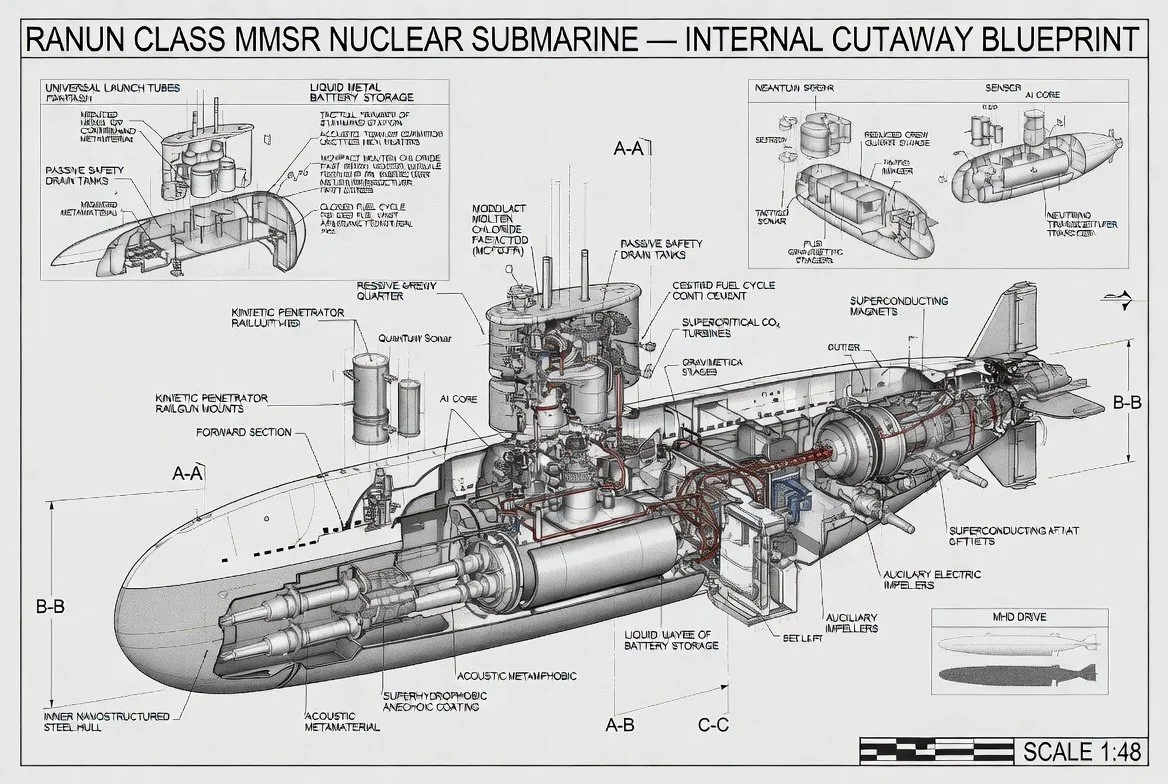
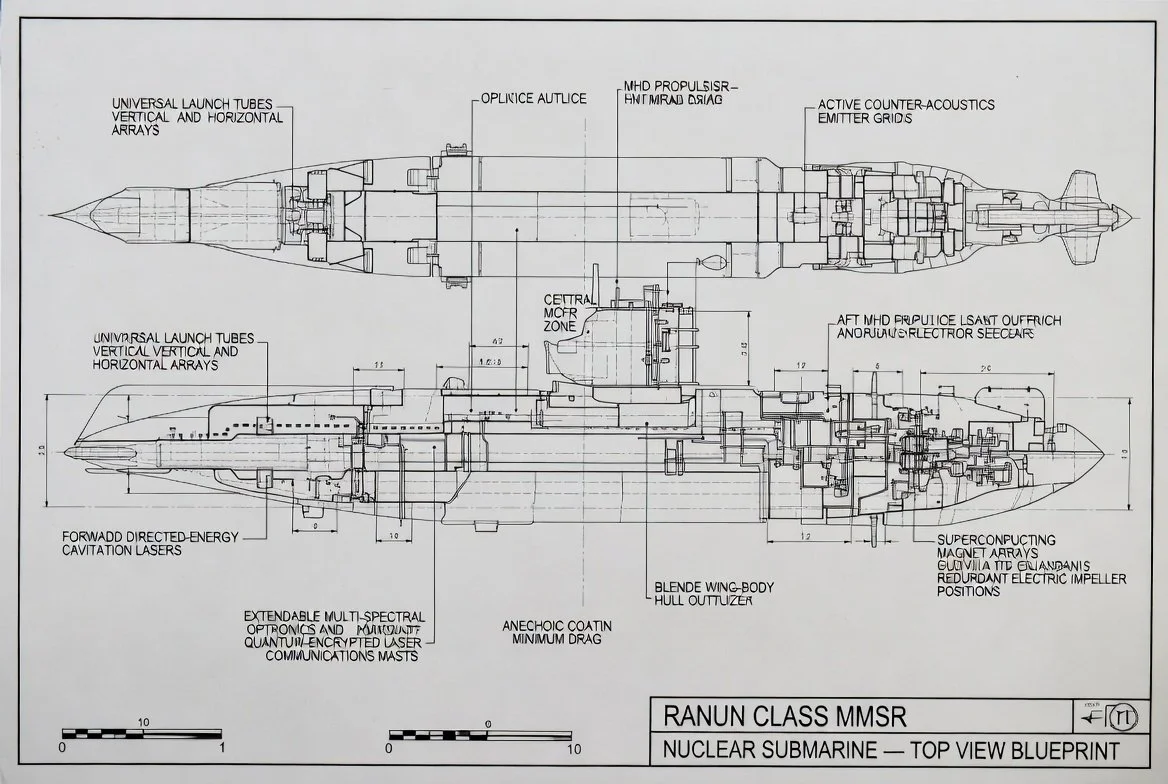
The "Ranun" Class MMSR Nuclear Submarine: Apex Predator of the Abyss
Overview: The Ranun-class isn't just a submarine; it's a self-contained, virtually omniscient, and utterly devastating platform designed for indefinite, undetected operations. Its core is an advanced Modular Molten Chloride Fast Reactor (MCFR), providing unprecedented power density and inherent safety. This vessel redefines stealth, speed, and strategic reach.
1. Power Plant: The Modular Molten Chloride Fast Reactor (MCFR)
At the heart of Ranun is a compact, high-efficiency MCFR system, a quantum leap beyond traditional PWRs.
Core Design: Utilizes a highly enriched uranium or plutonium chloride salt blend, allowing for a compact, fast neutron spectrum core. The chloride salt's higher boiling point and better thermal conductivity than fluoride salts allow for smaller heat exchangers and higher power density. Passive cooling loops are integrated, meaning core melting is physically impossible; in an emergency, the salt drains into passively cooled dump tanks.
Fuel Cycle: Capable of operating on a closed fuel cycle, consuming its own waste and transuranics, vastly extending refueling intervals to potentially decades or even the full operational life of the Ranun-class submarine. This minimizes logistical footprints and virtually eliminates radioactive waste disposal issues for the vessel itself.
Power Output: Rated at an incredible 500 MW thermal, feeding directly into a supercritical CO2 (sCO2) Brayton cycle turbine system, which offers significantly higher thermal efficiency and a smaller footprint than steam turbines. This translates to an electrical output of approximately 200 MWe. This colossal power directly feeds the propulsion and all auxiliary systems.
2. Propulsion System: Magnetohydrodynamic (MHD) Drive with Direct Electric Redundancy
The Ranun eschews propellers for ultimate silence and speed.
Primary Propulsion (MHD): A series of powerful superconducting magnet arrays embedded in the aft section of the hull ionize seawater and accelerate it, generating thrust without any moving parts. This system offers unparalleled stealth, operating with zero cavitation and minimal acoustic signature. Top speed projections exceed 80 knots.
Auxiliary/Redundant Propulsion: High-efficiency, shrouded electric impellers provide silent maneuvering at low speeds and serve as a backup for the MHD system. These are directly driven by the MCFR's electrical output.
Energy Storage: A compact, high-density liquid metal battery array provides short-duration burst power for extreme maneuvers or silent ambush, recharging rapidly from the MCFR.
3. Hull Design and Materials: Hyper-Stealth and Indestructibility
The Ranun's hull is a masterpiece of hydrodynamics and material science.
Hydrodynamics: Optimized for laminar flow across all operating speeds, drastically reducing drag and turbulence. The hull shape is a blended wing-body design, minimizing pressure signatures.
Materials: Constructed from a triple-layered composite. The inner pressure hull is a super-hardened nanostructured steel alloy. The middle layer consists of active acoustic-absorbing metamaterials that can dynamically adjust their properties to cancel incoming sonar pings and absorb internal machinery noise. The outer layer is a self-repairing, superhydrophobic anechoic coating that actively reduces drag and makes detection almost impossible.
Active Counter-Acoustics: Micro-thrusters and active sonic emitters embedded in the hull generate counter-waves to cancel out residual machinery noise and mask the vessel's acoustic signature entirely.
4. Sensor and Communication Arrays: Omniscient Awareness
The Ranun possesses an unparalleled ability to perceive its environment and communicate.
Quantum Sonar: Utilizes entangled particle pairs to generate a sonar "ping" that cannot be jammed or detected by conventional means, offering precise, long-range imaging of the underwater environment.
Gravimetric Imagers: Advanced gravimetric sensors can detect subtle changes in the Earth's gravitational field caused by large underwater objects (like other submarines or surface ships), allowing passive detection and tracking at extreme ranges.
Multi-Spectral Optronics: Extendable masts deploy quantum-encrypted laser communication systems and hyperspectral imaging arrays for discreet, high-bandwidth data transfer when at periscope depth or above.
Neutrino Communication: For truly deep-sea, undetectable communication, a theoretical neutrino transceiver allows for low-bandwidth, instantaneous messaging through any medium, including the Earth itself. This remains theoretical, but the Ranun is designed with the infrastructure to integrate it once the physics is fully mastered.
5. Weapon Systems: Unconstrained Lethality
The Ranun carries a devastating arsenal.
Universal Launch Tubes: Multiple vertical and horizontal launch tubes accommodate advanced, high-speed torpedoes, hypersonic anti-ship missiles, cruise missiles with variable payloads, and even underwater drones equipped with specialized sensors or offensive capabilities.
Directed Energy Weapons: Forward-mounted, high-energy pulsed cavitation lasers capable of neutralizing incoming torpedoes or small submersibles at close range.
Kinetic Penetrators: Theoretical electromagnetic railgun-launched kinetic energy penetrators, designed to bypass active defenses and deliver devastating impact.
6. Automation and Crew: The Mind of the Machine
The Ranun Class Submarine's complexity demands advanced AI.
Crew Complement: Significantly reduced, with a highly trained crew focusing on strategic decision-making and system oversight.
AI Integration: A self-aware AI core manages all reactor operations, navigation, stealth protocols, and tactical decision support. It can operate the vessel autonomously for extended periods, optimizing performance and anticipating threats. Human override is always available but rarely necessary.
Get In Touch
If you're interested in working with us, complete the form with a few details about your project. We'll review your message and get back to you within 48 hours.